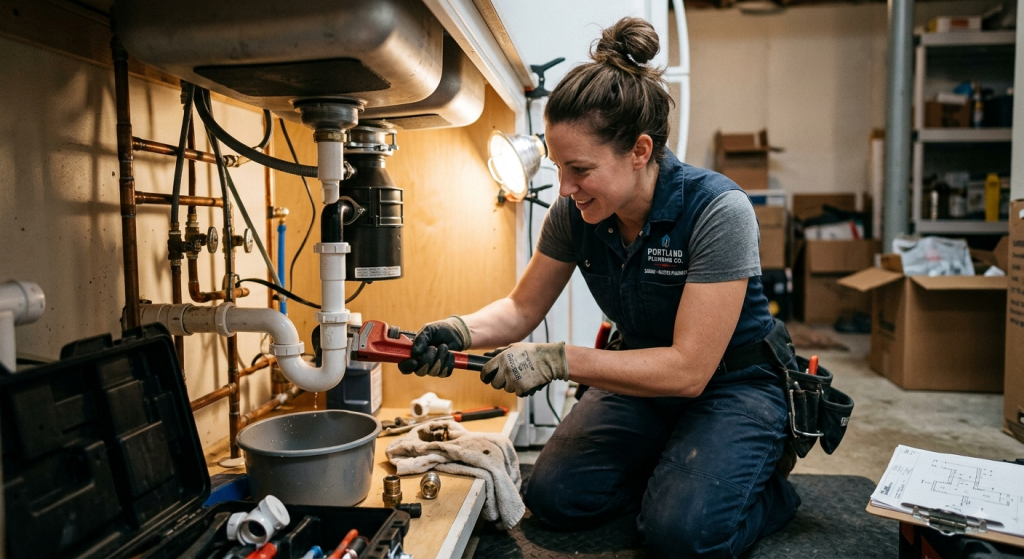
Plumbing
The plumbing trade is one of the most essential skilled professions, responsible for designing, installing, maintaining, and repairing the fluid and gas conveyance systems that ensure clean drinking water, safe sanitation, and proper climate/gas utility functions in homes, businesses, and industrial facilities.
Licensing & Career Progression
Plumbing is a highly regulated trade due to public health and safety impacts. Career advancement typically follows a structured licensing path:
[Apprentice] (4–5 Years)
  └─ Earn-while-you-learn under a Master/Journeyman; completes classroom & field hours.
       │
       ▼
[Journeyman Plumber]
  └─ Passed state exam; works independently on commercial or residential jobs.
       │
       ▼
[Master Plumber]
  └─ Advanced licensure; can pull permits, design systems, and run/own a plumbing business.
- Apprentice Plumber: Requires a high school diploma or equivalent. Apprentices complete 4,000 to 10,000 hours of paid on-the-job training alongside classroom study in plumbing math, code, and drafting.
- Journeyman Plumber: Achieved after passing a state/local licensing exam. Journeymen can work independently on complex residential, commercial, or industrial systems.
- Master Plumber / Contractor: The highest tier, requiring additional years of experience and advanced testing. Master plumbers can start their own contracting business, pull building permits, and supervise teams of plumbers.
Industry Outlook & Key Advantages
- High Demand & Job Security: Plumbing cannot be offshored or automated; every community relies on functioning water and sanitation infrastructure.
- Earning Potential: Entry-level apprentices earn wages immediately, with licensed Journeymen and Master Plumbers often earning $60,000 to over $100,000 annually, depending on region, overtime, and specialization.
- Specialization Opportunities: Plumbers can branch into green technology (solar water heating, rainwater harvesting, greywater systems), backflow testing, or gasfitting.
Primary Areas of Specialization
1. Residential Plumbing
- Overview: Focuses on single-family homes, townhouses, and small residential properties.
- Key Tasks: Installing fixtures (sinks, toilets, tubs, showers), repairing water heaters, unclogging drain lines, fixing pipe leaks, and running supply lines for appliances.
2. Commercial Plumbing
- Overview: Works on large-scale buildings such as office complexes, schools, hospitals, shopping centers, and restaurants.
- Key Tasks: Handling heavy-duty waste lines, commercial water boilers, grease traps, backflow prevention systems, and complex multi-story drainage networks subject to strict municipal codes.
3. Industrial Plumbing & Process Piping
- Overview: Serves manufacturing plants, power facilities, oil refineries, and food processing plants.
- Key Tasks: Installing high-pressure chemical, steam, gas, and water lines; handling specialized piping materials (like high-grade stainless steel or copper alloys); and integrating with heavy industrial machinery.
4. Service & Repair Plumbing
- Overview: Focuses on emergency calls, ongoing maintenance, and troubleshooting existing systems.
- Key Tasks: Camera inspections of sewer lines, trenchless pipe repair, water heater replacements, leak detection, and clearing stubborn blockages.
Core Systems & Responsibilities
- Potable Water Systems: Bringing clean, safe municipal or well water into a building under proper pressure.
- Drain-Waste-Vent (DWV) Systems: Carrying wastewater and sewage safely out of the building while venting gases through the roof to maintain proper pressure and prevent toxic sewer gas buildup.
- Gas Piping: Installing and servicing natural gas or propane lines for stoves, water heaters, furnaces, and outdoor equipment.
- Fixture & Appliance Installation: Hooking up water treatment devices, filtration systems, sump pumps, garbage disposals, and tankless water heaters.
Essential Skills & Technical Tools
| Skill / Tool Category | Details & Applications |
| Blueprint Reading & Code | Interpreting isometric piping drawings, understanding local plumbing codes, and ensuring compliance with sanitation standards. |
| Joining & Fabrication | Soldering/sweating copper pipes, threading steel gas pipes, solvent-welding PVC/CPVC, and crimping PEX tubing. |
| Diagnostic Equipment | Using video inspection cameras, digital manometers for gas pressure testing, and electronic leak detectors. |
| Safety Protocols | Strict adherence to Lockout/Tagout (LOTO), confined space safety, trenching/shoring rules, and biohazard protocols. |